Retail checkout counters are prime real estate for one more brand touchpoint, and a well-chosen bag turns a single transaction into a walking billboard. This guide breaks down what actually matters when you're sourcing custom shopping bags for retail checkout giveaways in 2026, and which bag types earn a Buy verdict versus a Skip.
- Non-woven recycled PET bags win for retail checkout giveaways in 2026 — durable, cheap per unit, easy branding. Buy.
- Kraft paper bags suit boutique and gift retail but tear under 5kg loads. Consider for lighter goods only.
- Cotton canvas totes cost more per unit but get reused for months, extending brand visibility past checkout day.
- Skip single-color thin plastic bags — logo fades fast and customers bin them within a week.
Why this matters
A branded bag that leaves your store gets seen on public transport, in office kitchens, at school pickup — free impressions your logo doesn't get sitting on a shelf. Retailers that swap generic plastic for custom shopping bags for retail checkout giveaways report the bag itself becoming a repeat-use item, not landfill by the next morning.
The same logic applies at conferences and events, where a tote doubles as both packaging and a takeaway gift. Checkout retail is different though — the bag needs to survive the walk home with actual purchases inside, not just a brochure.
Who this is for
This guide is built for retail store owners and merchandising managers — fashion boutiques, homewares, pharmacies, specialty grocers — deciding what bag goes over the counter for every sale, seasonal promotion, or loyalty giveaway in 2026. If you're ordering bags purely as a one-off event freebie rather than a daily checkout item, your priorities shift toward branding impact over load capacity, and you'll want a lighter-weight option.
What to look for in custom shopping bags for retail
Material and sustainability signal
Customers now read the bag material as a brand statement, not just packaging. Kraft paper and recycled non-woven poly signal an eco-conscious retailer; thin single-use plastic signals the opposite and several state-level bag bans across Australia have already pushed retailers off it entirely. Pick a material your customer base expects, not just the cheapest quote.
Print method and durability
Screen printing holds up better than heat transfer on textured non-woven fabric and won't crack after a few folds. Digital print works fine on smooth kraft paper for full-color logos but check the supplier's colour-fastness claim before committing to a bulk order — a logo that fades after two washes on a cotton tote undercuts the whole point of the giveaway.
Size and gusset capacity
A bag that's too small for your average basket size gets double-bagged or ditched at checkout, killing the branding opportunity before it leaves the store. Match gusset depth to your typical purchase: a boutique selling folded apparel needs less depth than a homewares store moving boxed items.
Cost per unit at volume
Unit cost drops fast past the 250-piece mark for most bag categories, and retail checkout programs run through volume quickly — a mid-size store can go through 500-1,000 bags a month. Price against your actual monthly footfall, not a guess, or you'll reorder mid-season at a worse rate.
Turnaround and lead time
Seasonal promotions and pop-up launches don't wait. Confirm production and delivery timelines before you commit a design to print, especially if the bag ties to a dated campaign like a Christmas or EOFY sale.
Brand visibility and handle style
A logo printed too small or placed where the handle folds over it gets lost. Rope handles and reinforced die-cut handles both carry branding well, but rope handles read as a premium, gift-retail cue — die-cut handles read as everyday utility.
Top picks for retail checkout giveaways
Non-woven recycled PET tote — the safe pick. Handles loads up to roughly 8kg without stretching, runs in the $1-2 per-unit range at 500+ quantities, and takes screen print cleanly across the full panel. Retailers using this as their standard checkout bag in 2026 see it reused as a lunch bag or grocery tote for months after purchase. Buy.
Kraft paper bag with twisted handle — the boutique pick. Ideal for lighter goods under 3kg — apparel, gifts, cosmetics — and the paper stock takes full-color digital print well for detailed logos. It tears under heavier homewares loads, so match it to product weight before ordering. Consider for fashion and gift retail; Skip for hardware or grocery.
Heavyweight cotton canvas tote — the wildcard. Costs more per unit than paper or non-woven, but a well-made canvas tote gets carried for a year or more, extending brand exposure far past checkout day. Works best as a loyalty-tier giveaway rather than an every-purchase bag given the higher unit cost. Consider for VIP or loyalty program tiers.
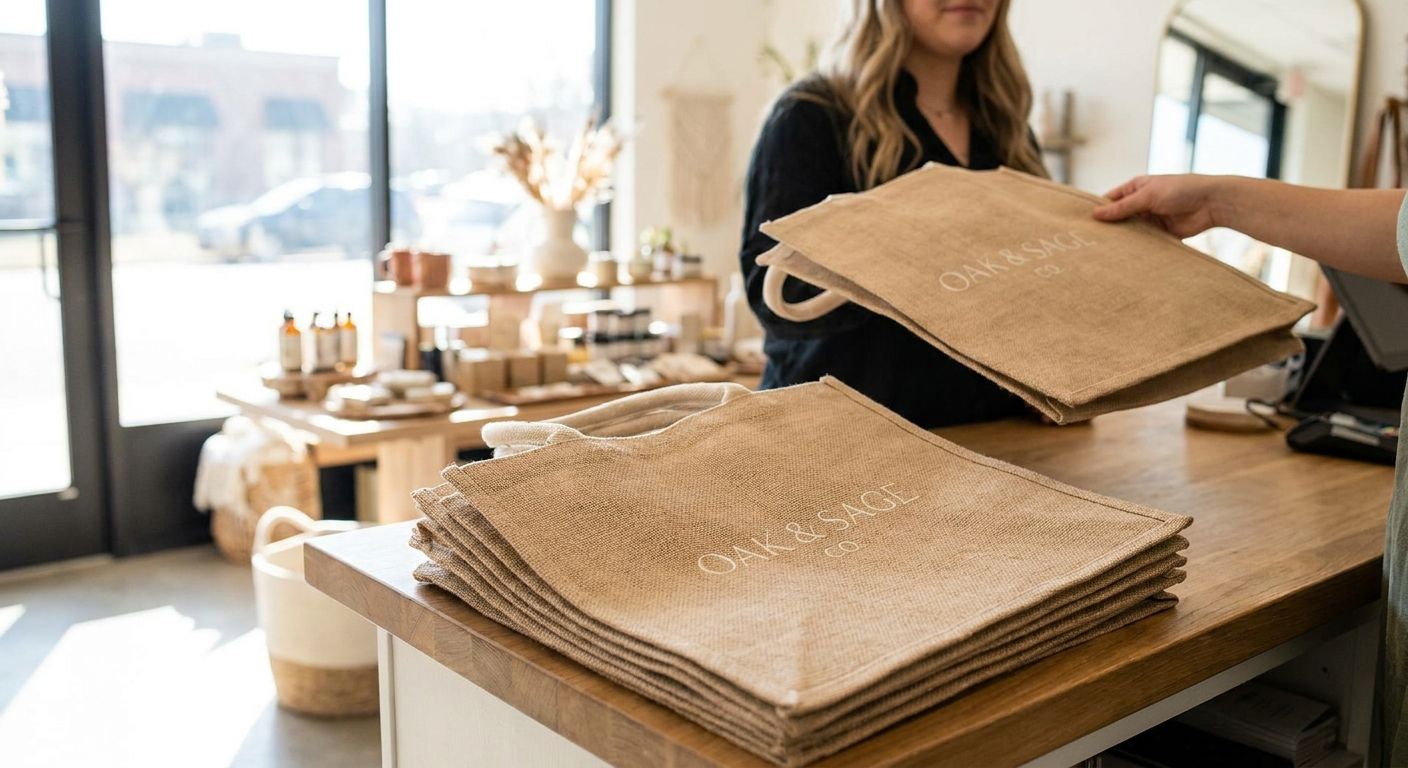
Jute bag with cotton lining — the premium pick. Reads as high-end and holds structure without a gusset seam failing, common on cheaper jute stock. Best suited to gift retail, wine and spirits, or specialty food stores where the bag itself is part of the unboxing. Buy for premium retail categories.
Thin single-use plastic bag — the one to leave behind. Cheapest unit cost on paper, but colour-fastness is poor, several Australian states restrict or ban lightweight plastic checkout bags outright, and customers bin it same-day, erasing any branding return. Skip.
What to avoid
- Undersized bags that force double-bagging — customers grab two, you pay for two, and the branding gets split across both.
- Single-color logo prints on dark non-woven fabric — low contrast means the logo reads as a smudge from across a room.
- Bulk orders locked to one size — retail checkout traffic varies by category; a fixed-size run leaves you overpaying for small purchases and under-serving large ones.
Verdict comparison
| Bag type | Load capacity | Cost tier | Reuse life | Verdict |
|---|---|---|---|---|
| Non-woven recycled PET | ~8kg | Low | Months | Buy |
| Kraft paper, twisted handle | ~3kg | Low-mid | Single to few uses | Consider (light goods) |
| Cotton canvas tote | ~10kg | Mid-high | 1+ year | Consider (loyalty tier) |
| Jute with lining | ~6kg | High | Months to years | Buy (premium retail) |
| Single-use plastic | Varies | Lowest | Days | Skip |
FAQ
What's the best custom shopping bag for retail checkout in 2026?
Non-woven recycled PET bags are the best all-round pick for retail checkout in 2026 — they hold up to 8kg, print cleanly, and cost roughly $1-2 per unit at 500+ quantities. Paper and jute suit specific retail categories rather than everyday checkout use.
Are paper bags better than plastic for retail branding?
Yes, for most retailers — paper bags carry a sustainability signal customers expect in 2026 and several Australian states restrict lightweight plastic bags outright. Paper works best for goods under 3kg; heavier items need a non-woven or cotton bag instead.
How many custom shopping bags should a retail store order at once?
Match the order to actual monthly footfall — a mid-size store typically moves 500-1,000 checkout bags a month, and per-unit pricing improves sharply past the 250-piece mark. Ordering below that threshold means paying a higher unit rate.
Do cotton tote bags work as checkout giveaways?
Cotton totes work best as a loyalty-tier giveaway rather than a standard checkout bag because the per-unit cost runs higher than paper or non-woven. The payoff is reuse life — a well-made cotton tote gets carried for a year or more.
What size gusset do retail shopping bags need?
Gusset depth should match your typical basket size — boutique apparel needs less depth than boxed homewares. Undersized gussets force customers to double-bag, which splits your branding across two bags instead of one.
How much does bulk custom branded bag printing cost in 2026?
Pricing drops sharply past 250-500 units and varies by material — non-woven and kraft paper sit at the lower end, cotton and jute at the higher end. Get a quote against your actual order volume rather than a per-unit estimate.
Is screen printing or digital printing better for retail bags?
Screen printing holds up better on textured non-woven fabric and resists cracking after folding, while digital printing suits smooth kraft paper for detailed full-color logos. Check the colour-fastness claim before committing to a bulk print run.
One last thing
The bag customers keep is the one that solves a problem after checkout — a lunch bag, a grocery tote, a gym carry. Design for that second life and the branding outlasts the sale by months, not minutes.