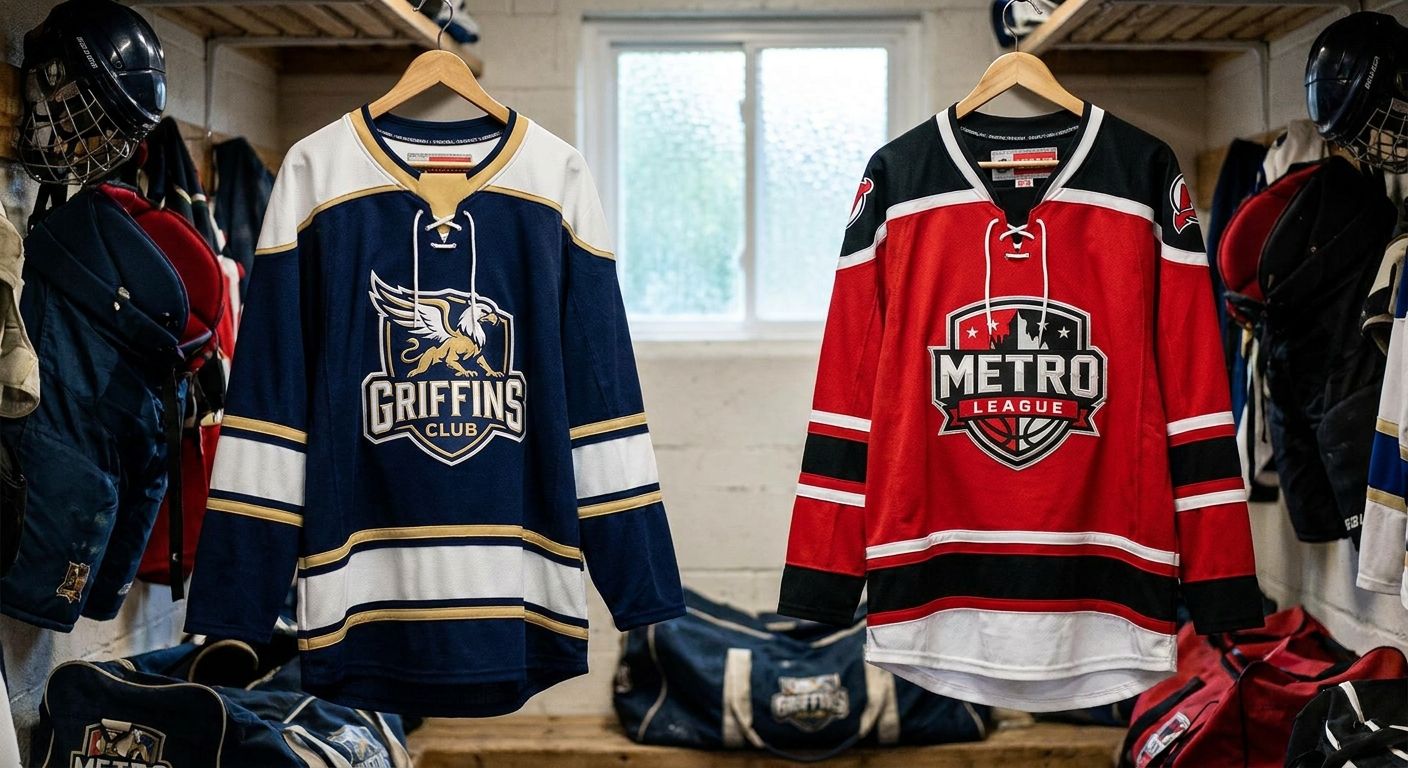
Custom hockey jerseys for clubs and leagues need to survive a full season of turf slides, sweat and repeat washing — not just look sharp in a design proof. This guide breaks down what club committees, team managers and league organisers should check before locking in a bulk jersey order for the 2026 season.
- Sublimated 160gsm polyester wins custom hockey jerseys for clubs — full-colour crests survive 200-plus washes. Buy.
- Skip screen-printed sponsor logos on multi-season kits; they flake after 20-30 washes, not 200.
- Junior-to-senior clubs need 8-10 size points, not a standard S-XL run, before any bulk order.
- Reversible mesh jerseys cut kit spend for school and junior squads juggling home and away colours.
- Embroidered heavyweight jerseys take 10-12 weeks — too slow if your 2026 season starts inside six weeks.
Why this matters
A hockey jersey takes more physical punishment per game than almost any other club uniform item. Turf slides, constant sweat exposure and a wash cycle every single week test the fabric and the decoration method at the same time. Get the fabric weight or the print method wrong and the club is reordering mid-season — which costs money and costs credibility with a sponsor whose logo is already peeling off the front panel.
Clubs sourcing custom hockey jerseys for clubs in 2026 are also juggling mixed rosters — juniors through to seniors — on one uniform budget, which means sizing range matters as much as fabric choice. High Quality Promo works through these decisions with club committees and league organisers every season, and the same handful of criteria come up on nearly every order, regardless of code or competition level.
Who this is for
This guide is for club committee members, team managers and league administrators ordering bulk hockey jerseys for a season, a tournament, or a full junior-to-senior program. If you're sizing 20 to 40 players across multiple age groups, coordinating a sponsor logo placement, or trying to lock in a supplier before pre-season training starts, the criteria below apply directly to your order — not a generic apparel checklist.
What to look for in custom hockey jerseys for clubs
Fabric weight and moisture-wicking performance
Hockey is played in short, high-intensity bursts, so a jersey that traps sweat gets heavier and slower by the second half. Look for polyester blends in the 140-160gsm range — light enough to wick moisture, heavy enough to hold shape after a tackle. Anything under 130gsm tends to go sheer under floodlights, which matters if your league runs night fixtures.
Sublimation vs screen print vs embroidery for crests and sponsor logos
Full sublimation dyes the print into the fibre itself, so it survives 200-plus wash cycles without cracking — critical for a jersey a junior wears every Saturday for a full season. Screen-printed logos sit on top of the fabric and start flaking after 20 to 30 washes, which looks identical to sublimation at pre-season photos and rough by round 10. Embroidery holds up longest on collars and small crests but adds weeks to production and isn't practical for a full-jersey sponsor panel.
Sizing range across junior and senior squads
A club running under-12s through to seniors needs 8 to 10 size points, not a standard S-XL run — junior hockey bodies don't scale evenly with adult sizing charts. Ask for a physical size sample set before committing to a bulk run of 40-plus jerseys. A sizing mistake at that volume is expensive to fix once the season has already started.
Wash-and-wear durability across a full season
A club jersey gets washed 20 to 30 times in a typical season once training kit doubles as match kit for some squads. Ask the supplier to confirm wash-cycle performance or, at minimum, the fabric weight and dye method used on comparable club orders. This is where sublimated polyester consistently outlasts cheaper printed alternatives, especially on the crest and sponsor panels.
Turnaround time against your season or tournament date
Sublimated jerseys typically take 4 to 6 weeks from approved art to delivery; embroidered heavyweight styles run 10 to 12 weeks. If your league season starts in six weeks, embroidery is already off the table. Plan backwards from round one, not from whenever the committee finally signs off on the design.
Minimum order quantities and per-jersey cost at scale
Bulk hockey jersey runs get materially cheaper per unit once you cross common production thresholds, so consolidating junior, senior and reserve squad orders into one purchase order usually beats ordering team-by-team. Confirm minimums and reorder timelines with your supplier before the committee locks a per-player price into the season budget.
Get a jersey quote before pre-season
Send your roster size chart and crest artwork for a bulk quote and free mockup.
Top picks for club and league hockey jerseys
The full-colour sublimated jersey — the safe pick. Built on 160gsm polyester with dye sublimated through the entire garment, this style holds crest and sponsor colour through 200-plus industrial washes without cracking. Turnaround sits at 4 to 6 weeks from approved art, which fits most club pre-season timelines. Verdict: Buy for senior club and multi-year league kits where the jersey needs to survive more than one season of wear.
The reversible mesh jersey — the budget stretcher. One garment, two colour panels, so a club fields home and away colours without ordering a second full kit run. It suits programs juggling junior and senior rosters where the uniform budget is split across 40-plus players. Compare it against a custom rugby jerseys for sports clubs and school teams order if your organisation runs both codes — the sizing and durability trade-offs are near identical across sports. Verdict: Buy for school and junior hockey squads on a tight kit budget.
The embroidered heavyweight jersey — the traditionalist. At 220gsm with an embroidered crest, this style reads as a premier or representative-side jersey rather than a weekend social kit. The trade-off is a 10 to 12 week turnaround, roughly double the sublimated option, and embroidery doesn't scale well to a full sponsor panel. Verdict: Consider for representative sides planning well ahead of the 2026 season; Skip if your season starts inside six weeks.
The moisture-wicking single-layer jersey — the lightweight option. A 140gsm single-layer build dries fast and suits indoor hockey or summer social competitions where turf abrasion isn't a factor. It won't hold up to a full season of outdoor club hockey the way a 160gsm sublimated jersey will, and the lighter weave shows wear faster on turf. Verdict: Consider for indoor and social comps; Skip for full-contact outdoor league play.
What to avoid
- Screen-printed sponsor panels on a multi-season jersey. They look identical to sublimation on day one and start flaking by round 10, which damages the sponsor relationship worse than skipping the logo placement entirely.
- Standard S-XL sizing on a junior-to-senior roster. A club running mixed age groups needs 8-10 size points or you'll be reordering individual jerseys mid-season at a premium rate.
- Embroidery on a compressed timeline. A 10-12 week production run doesn't fit a season that kicks off in six weeks, no matter how sharp the crest looks in the design mockup.
Verdict comparison
| Jersey type | Fabric weight | Turnaround | Best for | Verdict |
|---|---|---|---|---|
| Full sublimation | 160gsm | 4-6 weeks | Senior and multi-season league kits | Buy |
| Reversible mesh | 140-150gsm | 4-5 weeks | School and junior squads | Buy |
| Embroidered heavyweight | 220gsm | 10-12 weeks | Premier and representative sides | Consider |
| Moisture-wicking single-layer | 140gsm | 3-4 weeks | Indoor and social competitions | Consider |
FAQ
What's the best fabric for custom hockey jerseys for clubs?
Sublimated polyester in the 140-160gsm range is the best fabric for custom hockey jerseys for clubs in 2026 — it wicks moisture and holds full-colour print through 200-plus washes. Screen-printed jerseys use similar base fabric but the logo cracks far sooner.
Is sublimation better than screen printing for hockey jerseys?
Yes — sublimated dye survives 200-plus wash cycles without cracking, while screen-printed logos start flaking after 20 to 30 washes. Sublimation costs more per jersey but sponsor branding lasts the full season.
How many size points does a junior hockey club need?
A club running under-12s through to seniors needs 8 to 10 size points, not a standard S-XL range. Junior bodies don't scale evenly with adult sizing charts, so a physical sample set before bulk ordering avoids mid-season reorders.
How long does a custom hockey jersey order take?
Sublimated jerseys typically take 4 to 6 weeks from approved art to delivery in 2026, while embroidered heavyweight styles run 10 to 12 weeks. Order against your season start date, not your committee's design sign-off date.
Can one jersey work as both home and away kit?
Yes — a reversible mesh jersey with two colour panels lets a club field home and away colours from a single garment. It suits juniors and school teams where the uniform budget covers 40-plus players.
How many washes should a club hockey jersey survive?
A full season puts a jersey through 20 to 30 washes once training kit doubles as match kit. Sublimated polyester at 160gsm is built to hold colour and shape across that cycle count; cheaper printed jerseys are not.
Do embroidered jerseys work for a full sponsor logo?
Embroidery holds up well on collars and small crests but isn't practical for a full sponsor panel across the jersey front. Sublimation is the better call when a sponsor wants full-colour branding across the whole kit.
What should a club check before ordering hockey jerseys for 2026?
Confirm fabric weight (140-160gsm), print method, an 8-10 point size chart, and a turnaround date that lands before pre-season training starts. Skipping the size sample step is the most common reason clubs reorder mid-season.
One last thing
Most clubs lock in jersey art before they lock in the size chart, which is backwards. A sublimated print run can't be adjusted once the dye is set, but a size chart correction costs nothing if it's caught before cutting starts. Confirm your 8-10 size points first, then send the crest and sponsor logos through for sublimation approval — clubs that flip that order into their 2026 pre-season are the ones that aren't reordering jerseys by round 3.