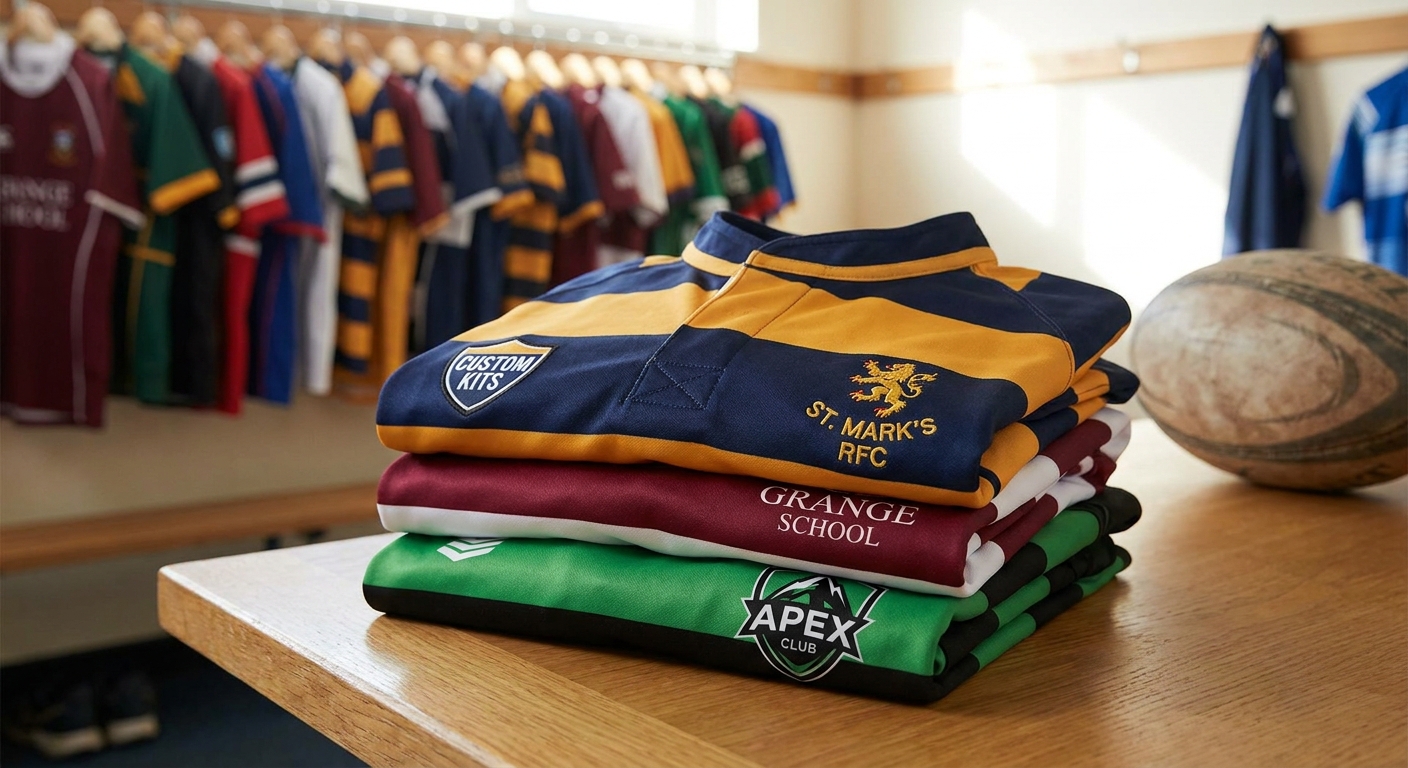
Picking custom rugby jerseys for sports clubs and school teams comes down to fabric weight, print durability and how fast a supplier can turn around a squad order before season kickoff. This guide breaks down what actually matters for club committees, PE coordinators and school sports coordinators ordering strips for 2026.
- Sublimated polyester jerseys are the buy for match-day squads needing sponsor logos and player numbers in 2026.
- Cotton-blend jerseys suit school teams that reuse kit across multiple seasons rather than one competitive year.
- Screen printing is cheaper per unit but fades faster than sublimation on high-contact positions like front row.
- Junior sizing runs from age 6 through adult 5XL, so confirm the full size chart before bulk ordering.
- Order 4-6 weeks ahead of round one to avoid rush fees on custom rugby jerseys for sports clubs.
Why this matters
A rugby jersey that looks sharp in the design proof but falls apart after three washes costs a club more in reordering than it saved on the cheaper quote. Clubs and schools buying in bulk for 2026 need a jersey that survives tackling, mud and a full competitive season, not just a photo for the sponsor.
Custom rugby jerseys for sports clubs also carry sponsor obligations and school branding rules that retail sportswear doesn't. Getting the fabric, print method and sizing right the first time matters more here than in almost any other bulk apparel category, because a mid-season reorder rarely arrives before the next fixture.
Who this is for
This guide is built for club committee members, school sports coordinators and team managers ordering 15 or more matching jerseys for a season, tournament or representative squad. If you're outfitting a single player or a social touch footy team, the calculus around fabric durability and sponsor print placement matters far less.
What to look for in custom rugby jerseys for sports clubs
Fabric weight and weave
Rugby is a contact sport, so jersey fabric needs to resist grabbing and tearing at the shoulder seams and collar. Heavier pique or mesh knits in the 160-200gsm range hold their shape better across a full season than lightweight athletic tees repurposed as jerseys.
Print method durability
Sublimation dyes the fabric itself, so the design never cracks, peels or fades from repeated washing and scrubbing out grass stains. Screen printing sits on top of the fabric and is cheaper for small runs, but sponsor logos and numbers on high-friction zones like the chest and back tend to crack within a season of weekly matches.
Sizing range across the squad
A club or school squad spans junior sizes through adult builds, sometimes in the same order. Confirm the supplier's size chart covers junior 6 through adult 5XL before committing, because a jersey run with gaps in the middle sizes means awkward substitutions on match day.
Team customisation options
Sponsor logos, player numbers, club crests and player surnames all need to sit cleanly on the jersey without competing for space. Ask whether names and numbers are included in the base print run or priced as an add-on per player, since that changes the real cost of a 22-player squad order.
Order minimums and turnaround
Bulk apparel runs typically favour larger orders, and school and club budgets rarely allow for a rushed reorder mid-season. Lock in your final roster and sizing at least a month before round one so sizing swaps don't become a scramble.
Budget versus longevity
The cheapest jersey per unit isn't the cheapest option if it needs replacing after one season. Compare cost per season of wear, not just cost per jersey, when weighing a premium sublimated kit against a basic screen-printed one.
Browse the full range of custom branded apparel at High Quality Promo before locking in fabric and print choices for your squad.
Top picks for 2026 rugby kit orders
The tournament-ready pick: full sublimation jersey
Sublimated jerseys print the design into the fibre rather than on top of it, so sponsor logos and player numbers survive a full season of scrums and washes without cracking. The fabric typically sits around 160-180gsm interlock knit, light enough for 80 minutes of running rugby but tough enough for front-row contact. Verdict: Buy for representative squads, finals series kit and any team where the jersey needs to look sharp in round 20 the same as round one.
The budget pick: screen-printed cotton-blend jersey
Screen printing costs less per unit on smaller runs, and a cotton-blend fabric holds up fine for school teams playing a shorter season with lower match frequency. The tradeoff is print cracking on high-contact zones after repeated seasons of wear, so this suits teams reordering kit every year or two anyway. Verdict: Consider for junior school teams and social competitions where budget outweighs multi-season durability.
The wildcard: moisture-wicking performance mesh
A lighter mesh weave built for heat management suits regional clubs playing in warmer conditions across spring and summer fixtures. It trades a little of the structured feel of pique fabric for breathability, which matters more in humid climates than most buyers expect. Verdict: Consider for clubs in warmer states or summer sevens competitions.
The school-safe pick: reinforced collar and shoulder jersey
School teams put jerseys through more grabbing and tackling practice than club sides simply because of training frequency, so reinforced stitching at the collar and shoulder seams matters. This construction detail adds negligible cost but meaningfully extends the jersey's usable life across a school sporting calendar. Verdict: Buy for school PE departments outfitting multiple year-level teams from one order.
The one to skip: unbranded generic sportswear
Off-the-shelf blank jerseys without proper print integration look inconsistent once sponsor logos and numbers get added as an afterthought, and they rarely match the club's actual colours precisely. Verdict: Skip for any club or school ordering jerseys tied to sponsor agreements or official uniform policy.
Get your squad kit sorted for 2026
Custom rugby jerseys with your club crest, sponsor logos and player numbers.
What to avoid
- Fabric that looks right in a swatch but hasn't been rugby-tested. A photo sample doesn't show how a weave handles grass stains, mud and repeated hot washes across a season.
- Sizing charts built for casual wear, not sport. Athletic cut jerseys run tighter through the shoulders than standard tee sizing, and a straight size-for-size swap from last year's supplier can leave players in jerseys that restrict tackling motion.
- Print placement that ignores squad numbers. A design that looks clean on a mockup with a single sample number can crowd badly once every player's individual number and surname gets applied.
Verdict comparison
| Criteria | Full sublimation | Screen-printed cotton-blend | Performance mesh | Reinforced school jersey |
|---|---|---|---|---|
| Best for | Competitive/rep squads | Budget school teams | Warm-climate clubs | Multi-team school orders |
| Durability across season | High | Moderate | Moderate-high | High |
| Sponsor logo longevity | Excellent | Fair | Good | Good |
| Relative cost per unit | Higher | Lower | Mid | Mid |
| Verdict | Buy | Consider | Consider | Buy |
FAQ
What's the best fabric for custom rugby jerseys for sports clubs?
A 160-200gsm pique or interlock knit is the standard for club and school rugby jerseys in 2026, since it balances stretch, breathability and resistance to tearing during tackles.
Is sublimation better than screen printing for team jerseys?
Sublimation lasts longer because the design is dyed into the fabric rather than sitting on top of it, so sponsor logos and numbers don't crack after repeated washing across a full season.
How far ahead should a club order custom rugby jerseys?
Confirm final squad numbers and sizing at least a month before the first fixture, since sizing corrections and reorders get harder to manage once the season is underway.
Can school teams order junior and adult sizes in the same run?
Yes, most bulk jersey suppliers cover junior through adult 5XL in one order, which matters for school squads spanning multiple age groups or staff-versus-students matches.
Do custom rugby jerseys usually include player names and numbers?
It varies by supplier and print method, so confirm whether names and numbers are part of the base jersey price or an added cost per player before finalising a squad order.
What's the difference between club and school rugby jersey needs?
School teams typically need heavier reinforcement at the collar and shoulders due to higher training frequency, while club teams competing in finals lean toward sublimation for sponsor logo durability.
Are cheaper screen-printed jerseys worth it for one-season use?
Screen printing suits teams reordering kit every year or two anyway, since the lower per-unit cost outweighs the print durability tradeoff over a short usage window.
What ruins a custom rugby jersey order the fastest?
Ordering from a size chart built for casual apparel rather than athletic cut is the most common mistake, leaving players in jerseys too tight through the shoulders for tackling movement.
One last thing
The detail most clubs skip is asking for a physical fabric swatch before committing to a full squad run: a photo mockup shows the print design, but it never shows how the weave actually handles a full 80-minute match in the rain. Request a swatch alongside the design proof for any 2026 order over 15 jerseys.